Hinges and Halts: The Field-Gate Habit That Proofs a Gundog
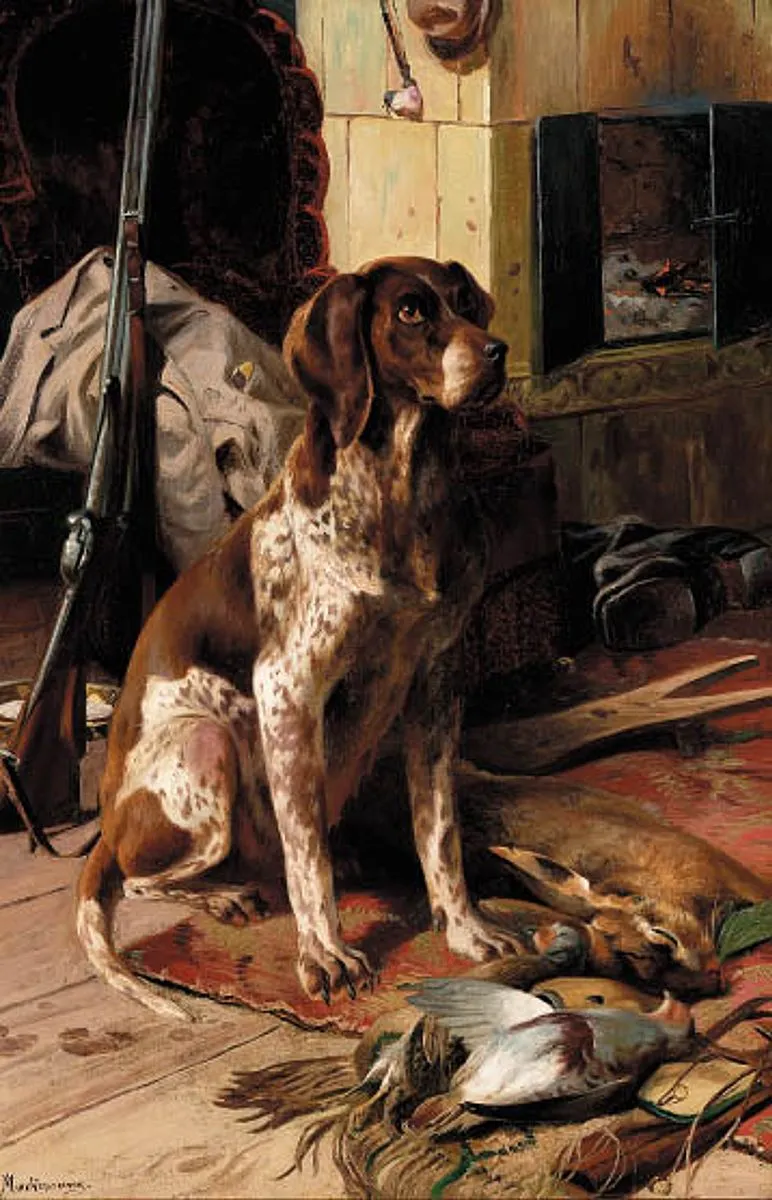
Photo: Adolf Mackeprang, Public domain, via Wikimedia Commons
Every Cotswold field has its pinch points. A five-bar gate, a stone stile, a kissing gate on a bridleway — these are the places where a dog has to choose between manners and momentum. On a shoot day, gateways are where dogs crowd, handlers hurry and sheep seem to appear from nowhere. At a trial, they are where judges quietly note whether a dog enters and exits with control or whether it spills through like water through a sluice.
That makes the gate one of the most useful training props you own. You do not need a dummy launcher, a penned rabbit or a spare hour. You need a gate, a lead and five minutes of honest repetition. The aim is not to teach a party trick. It is to build the habit of pausing, checking in and moving through a boundary only when invited.
Why the gate is a fair test
A gate is fair because it is real. The dog wants what is on the other side, and so do you. The hinge, the latch, the awkward swing and the person coming the other way all add pressure without adding artificiality. A dog that can sit calmly while you wrestle a stiff latch in the rain is learning something that transfers directly to the peg, the trailer and the trial ground.
Gates also combine several skills in one small package: steadiness, handler focus, spatial awareness and neutrality around livestock and the public. That is a lot of value for a piece of ironmongery you were going to walk through anyway.
The five-minute rule
Keep gate sessions short. One or two clean repetitions are worth more than ten sloppy ones. If the dog is still keen and correct, stop. If the dog is losing its head, stop sooner. A gateway is a high-pressure spot, so rehearse success rather than failure. If a walker appears and the dog is not ready, step to one side, let them pass and use the moment as distance work rather than a test you are bound to fail.
A progression from novice to steady
1. The closed-gate sit
Start on the lead a few paces back from a closed gate. Ask for a sit. Open the gate, close it, and reward the dog for staying put. Do not walk through yet. The lesson is simply that the gate moving is not a cue to break. Repeat at different gates so the dog does not think one particular gate is the only one with rules. If the dog creeps forward, reset without a lecture and try again from further back.
2. The threshold pass
With the dog on a loose lead, ask it to wait while you open the gate. Walk through first, then invite the dog through with a quiet cue. Ask for a sit on the far side before you close the gate. The dog is learning that crossing a boundary is a sequence, not a race. Keep your body language calm and avoid blocking the dog with the lead. The lead is there for safety, not as a brake you use every time.
3. The off-lead wait
In a safe enclosed field, let the dog off the lead and approach a gate. Ask for a sit, open the gate and walk through. The dog should wait on the near side until called through. Then reverse it: have the dog wait while you close the gate, and release it only when you are ready. This is where you build the habit of the dog checking in at boundaries rather than assuming every open gate is an invitation.
4. The public-proof gate
Now add mild distraction. A friend opening the gate, a walker passing on the path, a dog on the other side of a hedge. The dog stays sitting while the gate is opened and closed. Reward calm, not excitement. Do not let strangers pet the dog at the gate; a working dog does not need to make friends at every stile. If the dog breaks, go back to the lead and reduce the distraction. Livestock should be introduced at a distance first, with the gate as a backdrop rather than a confrontation.
5. The shoot-day gate
On a real day, the gate is often crowded with people, guns, bags and other dogs. Practise waiting while others go through. Let the dog sit off to one side, clear of the swing of the gate. Open the gate, let the line pass, then take your dog through and sit it on the far side. Keep the whole thing boring. Boring is the goal. If you need a long line for safety, use one, but do not let it become a permanent excuse for poor position.
Common mistakes at the gate
The first is crowding. A dog with its nose at the hinge is a dog about to be tripped over, and a handler about to be pulled off balance. Teach a gate position: sit two paces back, slightly to one side. Use the same hand signal each time so the dog knows where the safe spot is.
The second is letting the dog push through first because it is easier in the moment. That single habit will cost you on a driven day when a gate opens onto a field of birds. The dog learns that the gate is the cue, not you.
The third is nagging. If you have said sit once, do not repeat it twelve times while you fiddle with the latch. Reset the dog, reposition and try again. A quiet handler is a clearer handler.
The fourth is making every gate exciting. If every gate leads to a retrieve or a hunt, the dog will load the gate with expectation. Sometimes open a gate, walk through, close it and go home. The gate should mean nothing more than a boundary you cross together.
The fifth is forgetting the close. Dogs notice the difference between an opening gate and a closing one. Practise both. A dog that sits while you swing a gate shut behind you is a dog that understands the job.
A habit, not a party trick
You do not need to set aside a training session for this. Use the gates you already meet on walks, on shoot days and at trials. Five minutes here and there, repeated across different fields and different weather, will do more for steadiness than a weekly drill in the same corner of the same field.
The Cotswold gate is a modest thing: oak, iron, a bit of mud and a latch that never quite works in gloves. But it is also a classroom. Teach the dog to pause there and you are teaching it to pause at every boundary that matters.