At the Peg: The Quiet Rules That Make a Driven Day Safer
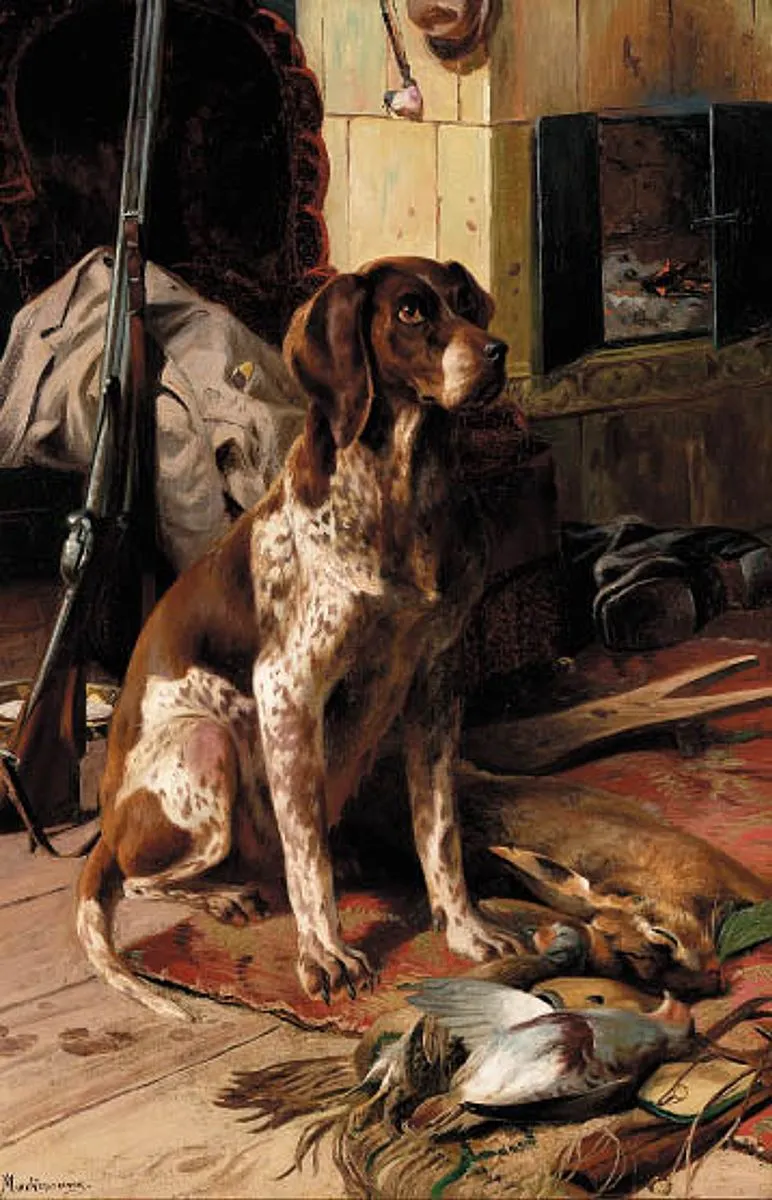
Photo: Adolf Mackeprang, Public domain, via Wikimedia Commons
There is a particular kind of silence that settles over a driven day just before the first bird. The guns are in place, the beaters are moving off, and the dog is watching the wood. In that moment, you can usually tell which handlers have done this before. They are not fiddling with leads or hissing instructions. They are standing still, and the dog is standing still with them.
Peg manners are often talked about as if they are simply a test of obedience. They are not. A dog can sit like a statue and still be a liability if it is placed in the wrong spot, if the handler is blocking a neighbour, or if nobody has told the pickers-up what to expect. Good dog work on a driven day is a small piece of theatre with a lot of health and safety behind it.
Obedience is the floor, not the ceiling
A steady dog is the minimum. It is not the whole job. At the peg, you are managing a live animal in a space shared with guns, beaters, pickers-up, and other dogs. The dog needs to understand the space. You need to understand the space. That means thinking about where the muzzle is pointing, where spent cartridges are falling, where the bird is likely to land, and where the dog can sit without being stepped on.
A dog that will not break is valuable. A handler who knows where to put that dog is more valuable still.
Position before the first bird
Get to the peg early enough to sort yourself out. Put the dog on the safe side, away from the gun's swing and away from the main track of beaters. If you are left-handed, think about it. If your neighbour is left-handed, think about that too. The last thing anyone needs is a dog sitting in the line of a swing because the handler was more interested in the flask than the field.
Keep the dog visible. A dog tucked behind a hedge may be out of the way, but it is also out of your control and out of sight of the pickers-up. A slip lead is useful here. It gives you something to hold without turning the peg into a wrestling match.
The safety arc
Think of a half-circle around the gun. The dog should be outside the arc when the gun is loaded and outside the line of the swing. Spent cartridges are hot and can land close. A dog that is allowed to root around at the peg may pick one up. That is not a training problem; it is a safety problem.
If the dog is young or excitable, keep it on the lead for the first drive. There is no prize for letting it off before it is ready. A lead is not a failure. It is a tool.
Steadiness is a conversation, not a freeze
Watch the dog. If it is staring at the sky, whining, or shifting its weight, it is telling you it is close to the edge. That is your cue to tighten the routine, not to start a new lesson. A quiet word, a hand on the shoulder, and a clear picture of where the bird has fallen will do more than a shouted command.
The best peg dogs are not the ones that look obedient. They are the ones that look settled. There is a difference, and the dog knows it.
Talk to people before the drive
This is the bit that gets skipped. Tell the pickers-up where you are standing and what your dog is like. If it is a young dog, say so. If it is steady but noisy, say so. If you would rather it did not get sent for a runner until you have had a word, say so. Pickers-up are not mind readers. Neither are beaters.
A thirty-second conversation at the start of the day can prevent a lot of confusion later. It also marks you out as someone who is thinking about the day rather than just their own dog.
The two-minute pre-drive brief
You do not need a laminated card. You need a short, repeatable check in your head before the first drive.
- Where is the dog sitting, and is it clear of the gun and the track?
- Is the lead on or off, and does the dog know which?
- Have I marked the likely fall of a bird, and have I got a clear recall or stop if I need it?
- Do the pickers-up know where I am and what the dog will do?
- What is my plan if the dog breaks, whines, or refuses a retrieve?
- Is the dog cool enough, warm enough, and watered enough for the next hour?
If you cannot answer those six questions, you are not ready for the drive. That is not a criticism. It is just a prompt.
Shot etiquette and the dog
A driven day is not a free-for-all. You do not shoot over a dog that is chasing a runner, and you do not send a dog for a bird that is not yours unless you have been asked. The peg is not the place to prove a point about your dog's drive. If a bird falls in front of you and another gun's dog is closer, let it go. A bit of restraint on the peg is worth more than a spectacular retrieve that nobody asked for.
When to put the dog away
Some dogs need a break. Some need to go back to the truck. A dog that is whining, lunging, or clearly stressed is not learning anything useful at the peg. It is just practising being wound up. Put it away, let it settle, and bring it out for the next drive if it is genuinely ready. A quiet dog in a crate is better than a wreck at the peg.
The uncomfortable truth is that many peg problems are handler problems. We get excited. We stand in the wrong place. We forget to tell the pickers-up. We treat the drive as a training session. The dog then gets blamed for reacting to a situation we created.
Mid-season is not the time for a big training overhaul. It is the time for small, boring standards. Stand still. Keep the lead on when you need to. Know where your dog is. Talk to the people around you. Let the dog do the job it has been trained for, and do not ask it to do anything else.
That is what peg manners really are: not a performance, but a quiet set of rules that keeps everyone safe and gives the dog the best chance of a good day.