Bent Backs and Cold Knees: Looking After the Handler, Not Just the Dog
Ask any keeper or picking-up team in the Cotswolds what ends a working partnership early and they will not say the dog. The dogs last. The dogs are bred for it, fed for it, exercised for it and generally treated better than most of us treat ourselves. What goes first is the human at the other end of the lead.
You know the type. Fit as anything in September, then a tweak in the lower back lifting a wet labrador into a truck box on the second day of the season. Two weeks on the sofa. Then a knee that doesn't fancy frozen ground in January. Then a chest that turns every cold wind into a fortnight of coughing. By the time the dog is four and finally coming into its own, the handler is fifty-one and thinking about giving up.
That isn't bad luck. It's an unmanaged season.
The dog is fitter than you, and it always was
A working labrador will do ten miles of a driven day in bursts and sleep it off. It has spent the summer swimming, roading and being generally kept in work. You, meanwhile, have driven to the shoot, stood about, and lifted a dog in and out of a vehicle twenty times. The mismatch is real, and the season finds it out by mid-November.
Handler welfare is dog welfare. A lame owner means a dog that sits in a kennel for six weeks in the middle of its working education. That's not sentimental — that's a training problem with a name and a recovery time on it.
Ten minutes before the first drive
Nobody warms up. We all know this. We arrive, we chat, we drink coffee from a flask, and then we walk a hundred yards and stand still for forty minutes.
Ten minutes is enough to change that. A brisk walk round the truck while the dog is airing, a few hip circles, a couple of gentle squats, shoulder rolls, and a slow stretch of the calves — particularly if you're going to be standing on a slope for the rest of the morning. Don't bother being self-conscious about it. Everyone will be doing it within three seasons anyway, and the ones who laugh are the ones who'll be ringing you for the name of your physio in February.
The truck box problem
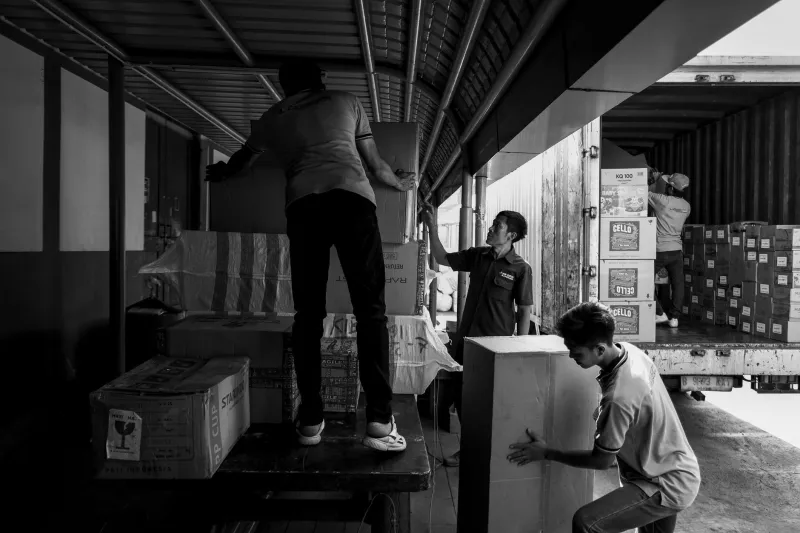
This is where most backs go. A wet labrador is not a light object, and a high box behind the cab is the worst combination of height and twist known to the working handler.
A few changes that make a genuine difference:
- Lower the load. A tailgate-height crate, a lower box, or a ramp removes the worst of it.
- Lift with the legs and keep the dog close in to your body. Half a metre out is a moment arm you don't need.
- Never lift and twist in the same movement. Put the dog down, then turn.
- Settle the dog before you lift. A wriggling dog under one arm is how shoulders go.
- Where possible, use a second person for the awkward ones, and tell your pride to be quiet about it.
An honest note on loading by lead and collar: if it turns into a hoist, get a ramp and train the dog to walk up it cleanly over a fortnight in July. It is one of the best afternoons of work you'll do all summer.
Feet and knees earn their keep
Frozen ground is unforgiving and standing on it is the bulk of the job. Wellies are waterproof and useless for support. A decent pair of country boots with grip, an ankle that holds, and a little cushioning will do more for your season than any supplement.
Spare socks in the truck are not a luxury. Damp feet on a cold day are the fastest route to a miserable afternoon and a slow one after that. Gaiters are worth their weight when the kale is wet.
For the knees, a pair of decent waterproof over-trousers and a layer that actually blocks wind beats three fashionable layers that don't. Wool underneath, windproof over the top, and a hat you can pull down over your ears. Cotton gets wet and stays wet, and a November wind in the Cotswolds finds every gap you leave.
Pace December, because December won't pace itself
The fixture list is the real enemy. Four days in eight, then a day off, then three more. Nobody wants to say no. Say no anyway, once. The dog benefits from a rest day as much as you do, and a fresh dog in January is worth more than a tired one on the fourteenth of December.
Share the driving where you can. Take the lunch break properly — sit down, eat something warm, drink something warm. A flask of soup in the truck at noon is the single cheapest performance aid available to a gundog handler.
The reckoning in February
When the season closes, most of us put the whistle in a drawer and do nothing until August. That's the fortnight where the back, the knees and the general fitness could be quietly rebuilt — and it's the fortnight that decides whether you're still doing this at sixty.
A walk a day, a bit of strength work, a decent pair of boots replaced before they leak. Nothing heroic. The dog is going to be ready. There's no reason the handler shouldn't be.