Hoofprints in the Scent Cone: Steadying a Gundog Around Deer Without Dulling Its Drive
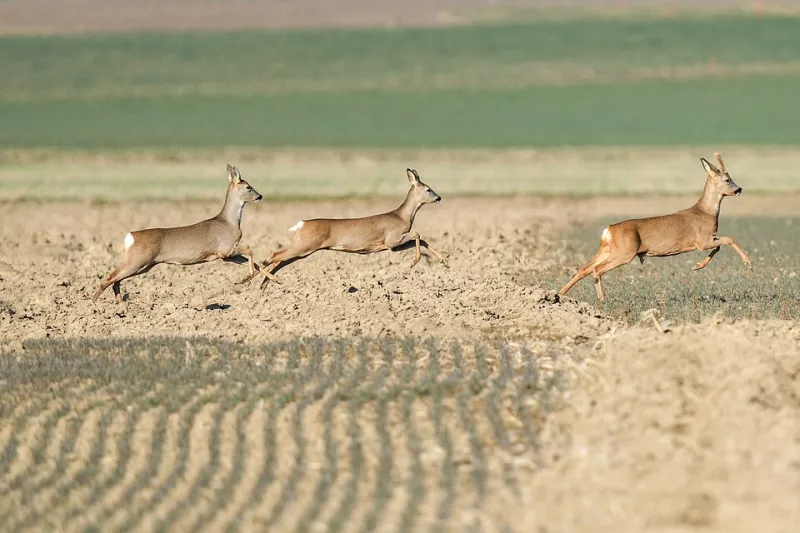
Photo: Giles Laurent, CC BY-SA 4.0, via Wikimedia Commons
Every Cotswold handler has a version of the same story. A quiet drive, a good line, a dog working nicely at twenty yards — and then a roe doe breaks from the kale and everything goes sideways.
Deer are the biggest hole in most gundog training programmes. We proof dogs against sheep, against chickens, against the neighbour's cat. Then a hundredweight of muntjac appears out of a hedge and we discover the training never covered it.
The Problem With Hooves
Ground game presents a gundog with a genuinely difficult ask. It smells like quarry. It moves like quarry. It flushes like quarry. And unlike a pheasant, it doesn't get up and fly away — it runs, which triggers a chase instinct far older and far stronger than anything a bird will pull out of a dog.
Add to that the fact that deer are increasingly common across the Cotswolds, often in places where a shoot is running a driven day next door, and you have a dog being asked to make a very fine distinction under real pressure: that smell is quarry, but not your quarry.
How a Dog Actually Meets a Deer
Dogs rarely meet deer nose to nose. They meet the scent cone first, often long before the deer is visible, and the way that cone behaves matters enormously.
On a still, damp morning, scent sits low and travels far. A dog working into a headwind can catch a roe at a hundred yards and start pulling hard with nothing at all in view. On a gusty day, scent eddies and pools, and the same dog may get a face full of it sideways with no warning. That's when you see a dog spin, lift its head and lose the plot entirely.
Understanding this changes how you train. You're not teaching a dog to ignore a visible animal. You're teaching it to keep working a pattern when its nose is telling it something far more interesting is over there.
Seasons, Law and the Practical Reality
Deer seasons vary by species and by where you are. Roe bucks are generally in season from April to the end of October, roe does from November into late February; the larger species follow different calendars, and muntjac can be dealt with year-round under licence. None of that matters much to a dog.
What matters is this: a gundog chasing deer is a welfare problem, a legal problem and a public relations problem in one. A chased deer can be pushed onto roads, into fences or into a long, stressed run. A dog can be injured by a deer, or by a fence it didn't see. And on a shoot day, a dog that disappears after a deer is a dog that ruins the drive for everybody and puts the shoot's relationship with the landowner on thin ice.
So the aim isn't perfection. It's a dog that stops, turns and comes back when you ask — even when its nose is screaming at it.
Proofing That Builds Steadiness, Not Shut-Down
Here's where I'd push back hard on some of the advice doing the rounds. You cannot correct a dog out of prey drive without paying for it somewhere else. Hammer a young spaniel every time it shows interest in ground scent and you'll get a dog that is steady around deer and hesitant around everything else. That's not training. That's damage.
What works better is a layered approach.
Start with a stop that actually holds
Not a stop that holds in the garden. A stop at distance, on scent, with the wind in the dog's face and something worth chasing. Build it on dummies first, then on cold game, then in cover. If the stop isn't reliable in a bare field, don't take it to a wood.
Use the recall as your emergency brake
I want two tools: a stop and a turnaround whistle. The stop freezes the situation. The turnaround gets the dog back and gives it a job. A dog that returns to a whistle and gets sent on a hunt is a dog that learns you're worth listening to.
Practise on scent, not on sight
Find ground where deer have been — a gateway, a hedge line, a ride through a copse — and work your dog through it on a pattern. No deer needed. What you're rewarding is the dog's willingness to stay with you when the air is telling it a different story. Sessions like this are short, calm and boring. They work.
Add distance gradually
Once the dog will hold its pattern on fresh deer scent at ten yards, stretch it to twenty, then forty. If it blows through the whistle twice in a row, you've gone too far too fast. Back up, shorten the session, finish on a win.
The Over-Correction Trap
I've seen good dogs ruined by handlers who decided the answer to deer was a hard correction every time the dog showed interest. What they ended up with was a dog that wouldn't push into cover, wouldn't get its head down, and cast a nervous eye at every rustle in a hedge.
Remember what a gundog is for. It hunts. If you punish hunting, you don't get steadiness — you get a dog that has stopped offering behaviour, and that's a much harder problem to fix than a bit of pulling on deer scent.
Save your strongest response for the moment the dog actually commits to a chase. Everything before that is information, not defiance.
A Realistic Cotswold Progression
If I were starting a young dog on this ground now, I'd spend the autumn doing three things: working scent lines in known deer country on a long line, proofing the stop at increasing distances, and taking the dog on walked-up days where deer are likely but the pressure is low. I'd keep sessions under fifteen minutes. I'd finish while the dog still wants more.
And I'd accept that a first season will include at least one incident. Nearly every working dog has a deer-shaped hole in its education at some point. What matters is what you do in the ten seconds afterwards — and whether your dog comes back thinking you're still the most interesting thing in the field.
Aim for a dog that's steady in the wood and still keen in the yard. Anything else is a compromise you'll regret.